19. Acute Neurological, Environmental, and Critical Care Emergencies
Acute central nervous system catastrophes and extreme environmental exposures produce profound neurohormonal surges that manifest as dramatic electrocardiographic abnormalities mimicking acute myocardial infarction.
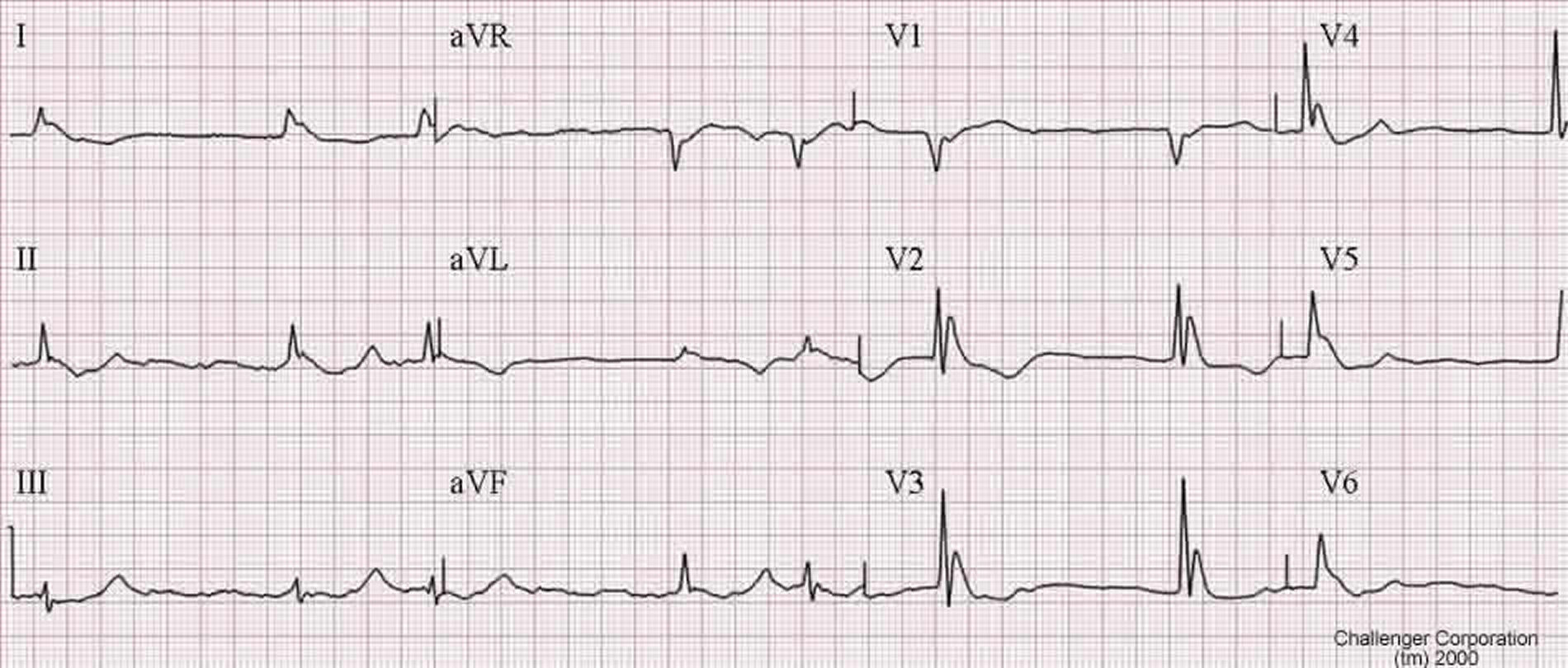 Figure 19.1: 12-lead ECG in severe Hypothermia showing prominent Osborn (J) waves at the J-point, baseline somatic muscle tremor artifact, and marked bradycardia. Rendered with solid white background.
1. Intracranial Hemorrhage & Neurogenic "Cerebral T Waves"
- Pathophysiology: Massive intracranial pressure elevation (Subarachnoid Hemorrhage [SAH], severe traumatic brain injury) triggers a massive sympathetic hypothalamic-medullary surge, releasing excessive norepinephrine directly into myocardial nerve terminals and causing focal myocyte necrosis (contraction band necrosis / neurogenic stunned myocardium).
- Electrocardiographic Hallmarks:
- "Cerebral T Waves": Enormous, wide, deeply inverted, symmetrical T waves ($>10-15\text{ mm}$ amplitude) across precordial leads ($V_1 - V_6$) and limb leads.
- Extreme $QTc$ Prolongation: Frequently exceeding $600-700\text{ ms}$.
- Prominent U waves and sinus bradycardia.
- Transient ST-segment elevation or depression mimicking acute STEMI.
2. Hypothermia & The Osborn (J) Wave
- Pathophysiology: Severe core hypothermia ($<32^\circ\text{C}$) exaggerates the transmural voltage gradient by selectively prolonging epicardial $I_{to}$-mediated action potential notches relative to the endocardium.
- Electrocardiographic Triad:
- Osborn Wave (J Wave): Prominent positive dome-shaped deflection at the junction of the QRS complex and ST segment (height is directly proportional to the severity of hypothermia).
- Baseline Somatic Tremor: High-frequency shivering muscle artifact.
- Progressive Conduction Slowing: Sinus bradycardia $\to$ PR/QRS/QT prolongation $\to$ slow atrial fibrillation $\to$ spontaneous Ventricular Fibrillation ($<28^\circ\text{C}$) or asystole.
3. Evidence-Based Emergency Resuscitation Protocols
- Severe Hypothermia Resuscitation:
- Continuous core temperature monitoring (esophageal/bladder).
- Active Core Rewarming: Warmed IV fluids ($40-42^\circ\text{C}$), humidified heated oxygen, bladder/peritoneal lavage, or Extracorporeal Life Support (ECLS / ECMO).
- In ventricular fibrillation at core temp $<30^\circ\text{C}$: Attempt initial defibrillation up to 3 shocks; defer further shocks and medications (epinephrine) until core temp $>30^\circ\text{C}$ due to impaired hepatic/renal drug clearance.