10. Inherited Channelopathies and Sudden Cardiac Death Syndromes
Primary electrical channelopathies are genetic ion channel disorders that predispose children with structurally normal hearts to malignant ventricular tachyarrhythmias, syncope, and sudden cardiac death.
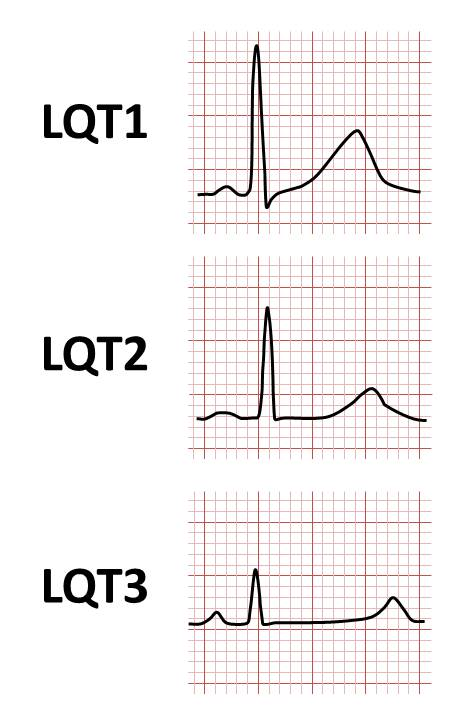 Figure 10.1: Characteristic T-wave morphologies across Long QT Syndrome subtypes: LQT1 (broad-based), LQT2 (notched/bifid), and LQT3 (long isoelectric ST with late peaked T). Rendered with solid white background.
1. Clinical Presentation & Environmental Triggers
- LQT1 ($KCNQ1$): Syncope triggered by physical exertion, specifically swimming / diving or emotional stress.
- LQT2 ($KCNH2$): Syncope triggered by auditory stimuli (alarm clocks, doorbells, ringing telephones).
- LQT3 ($SCN5A$): Events occurring during rest or sleep / bradycardia.
- CPVT ($RyR2$): Emotion or exercise-induced polymorphic/bidirectional VT in childhood with completely normal resting 12-lead ECG.
2. Diagnostic Electrocardiographic Criteria
Schwartz Diagnostic Score for Pediatric LQTS:
| Diagnostic Parameter | Clinical Finding | Score Points |
|---|---|---|
| $QTc$ (Bazett) | $\ge 480\text{ ms}$ | 3 |
| $460 - 470\text{ ms}$ | 2 | |
| $450\text{ ms}$ (in males) | 1 | |
| T-Wave & Rhythm Signs | Torsades de Pointes | 2 |
| T-wave alternans | 1 | |
| Notched T wave in $\ge 3$ leads | 1 | |
| Low resting heart rate for age ($<2\text{nd}$ %ile) | 0.5 | |
| Clinical History | Syncope with physical/emotional stress | 2 |
| Syncope without stress | 1 | |
| Congenital sensorineural deafness (Jervell & Lange-Nielsen) | 0.5 | |
| Family History | Family member with definite LQTS | 1 |
| Unexplained sudden cardiac death in 1st-degree relative $<30$ yr | 0.5 |
Interpretation: Score $\ge 3.5$ = High probability; $1.5 - 3.0$ = Intermediate; $\le 1.0$ = Low probability.
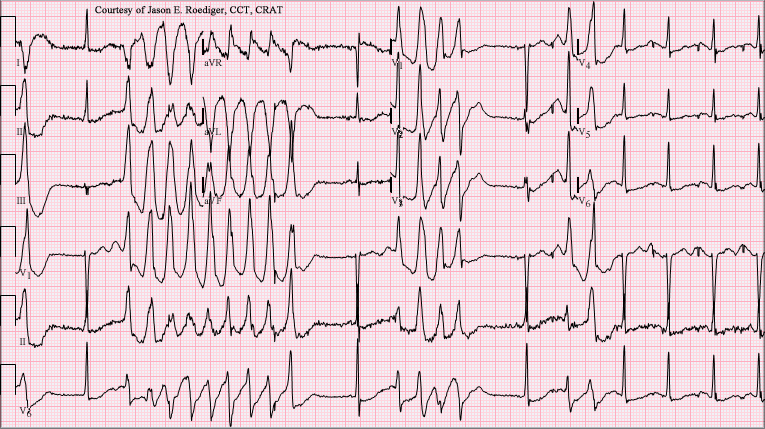 Figure 10.2: Torsades de Pointes showing classic polymorphic sinusoidal twisting around the isoelectric axis.
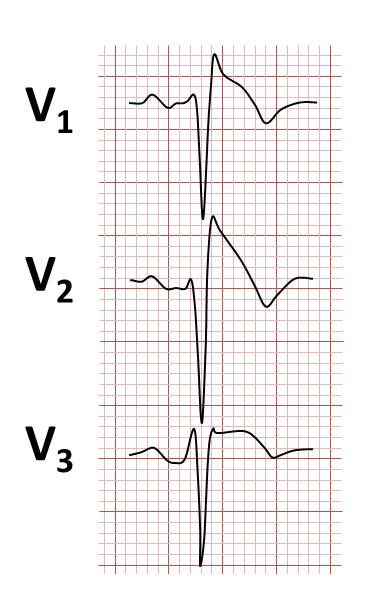 Figure 10.3: Type 1 Brugada Pattern: Coved ST-segment elevation >= 2 mm followed by an inverted T wave in right precordial leads.
3. Multimodality Investigations
- Exercise Treadmill Testing (ETT): Evaluates $QTc$ behavior during recovery (failure of $QTc$ to shorten or paradoxical prolongation at 4th minute of recovery $\ge 480\text{ ms}$ indicates LQTS).
- Next-Generation Genetic Sequencing: Direct sequencing of $KCNQ1, KCNH2, SCN5A, RyR2, CASQ2, CACNA1C$.
4. Evidence-Based Clinical Management Protocols
- First-Line Pharmacotherapy: Non-selective Beta-Blockers (Nadolol $1-2\text{ mg/kg/day}$ or Propranolol $2-4\text{ mg/kg/day}$). Metoprolol is inferior and not recommended in LQTS.
- Mexiletine / Ranolazine: Added in LQT3 as a late sodium channel current ($I_{Na,L}$) blocker.
- Flecainide: Highly effective in CPVT by suppressing calcium sparks from mutated $RyR2$ channels.
- Left Cardiac Sympathetic Denervation (LCSD): Video-assisted thoracoscopic excision of lower third of left stellate ganglion for refractory syncope.
- Implantable Cardioverter-Defibrillator (ICD): Indicated for survivors of cardiac arrest or breakthrough syncope on maximal medical therapy.